Jan 27, 2026
Why AI Engineering hiring is now defined by ownership, not models
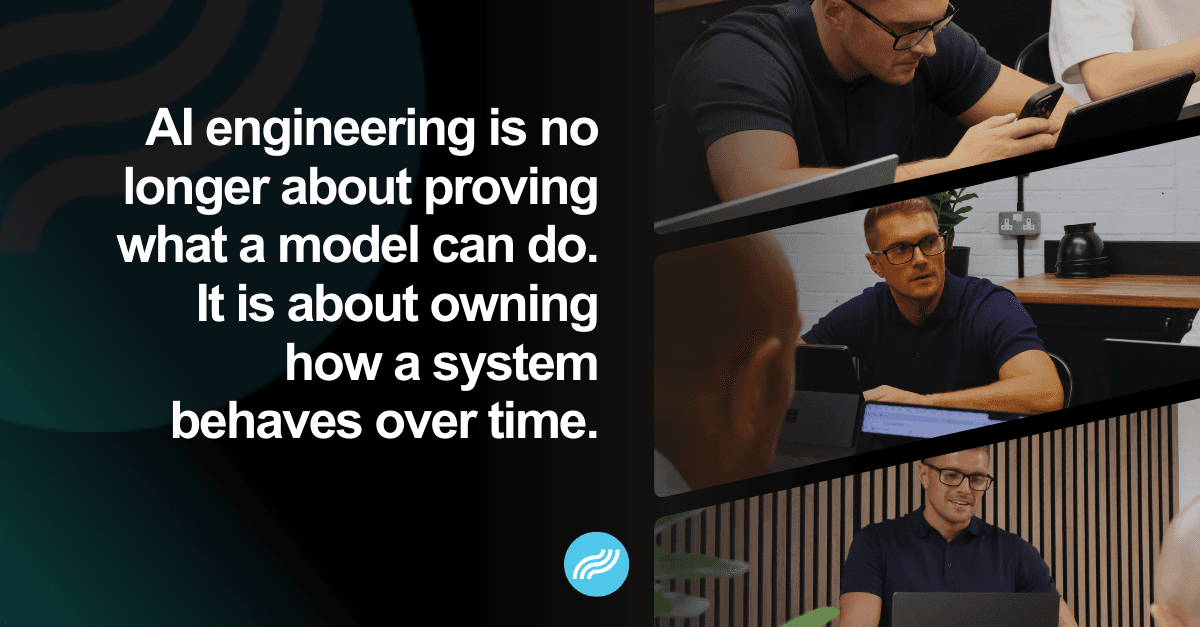
Written by Brad, one of our Principal Consultants, here at Tides Digital, this piece reflects what he is seeing across AI engineering hiring as teams shift their focus toward ownership and production responsibility.
Over the last year, AI engineering hiring has shifted in a way that many teams felt before they could fully articulate it. The challenge is no longer finding people who understand models. The challenge is finding engineers who are prepared to own what happens when those models live inside real systems.
I hear this consistently from AI leaders. Training a model is rarely the hardest part anymore. The complexity shows up after deployment. Monitoring performance, managing drift, handling edge cases, controlling cost and maintaining reliability over time is where teams feel pressure.
That reality has changed how AI engineers are evaluated.
When hiring managers talk to candidates now, they spend less time on algorithms in isolation and more time exploring ownership. They want to understand what an engineer has taken responsibility for once a model entered production. How they thought about evaluation. How they handled failure. How they balanced accuracy with latency and cost.
Engineers who have worked close to production tend to speak differently. They talk about systems rather than models. They describe trade-offs, constraints and second-order effects. They understand that AI systems behave unpredictably over time and require care, not handoff.
This shift is showing up clearly in hiring outcomes.
Roles framed around building or experimenting with models often struggle to convert at senior level. Candidates want clarity on what happens next. Roles that describe ownership across deployment, iteration and reliability tend to attract engineers who are confident in their ability to deliver impact and realistic about responsibility.
Interview processes are evolving alongside this. AI engineering interviews are moving away from theoretical discussions and toward real-world scenarios. Teams want to know how candidates reason about production incidents, data quality issues, evaluation failures and system design under constraint. These conversations reveal far more about future performance than familiarity with a specific library.
Ownership has also become central to retention in AI teams.
Engineers who understand what they own and how success is measured are more engaged. Ambiguity around responsibility often leads to frustration, particularly in AI environments where outcomes are harder to predict. Hiring with ownership in mind creates clarity that supports long-term performance.
For TA leaders and recruiters working in AI, this shift requires deeper technical context and closer alignment with engineering leadership. Translating ownership into role scope, interview focus and candidate messaging is no longer optional. It is how strong teams are built.
What I am seeing across AI engineering hiring is a move toward maturity. Not in hype or tooling, but in accountability. Teams that hire for ownership are building systems that hold up under pressure and engineers who stay close to the outcomes they create.
AI engineering is no longer about proving what a model can do. It is about owning how a system behaves over time.
At Tides, this is a consistent signal we look for when supporting AI teams. When ownership is clear, hiring moves with confidence. When it is missing, friction appears early. Understanding that difference has become one of the most valuable parts of the hiring process
Articles


