Feb 6, 2026
Tech hiring myths some leaders still believe in 2026
Hiring conversations across tech and AI feel different in 2026. Teams are moving carefully, expectations are sharper and decision-making carries more weight than it did even a year ago. Yet many hiring discussions are still shaped by assumptions that belong to an earlier market.
Some of those assumptions help leaders navigate complexity. Others introduce friction that quietly slows progress. The difference matters because hiring decisions now influence system reliability, delivery quality and organisational confidence in ways that extend far beyond filling a seat.
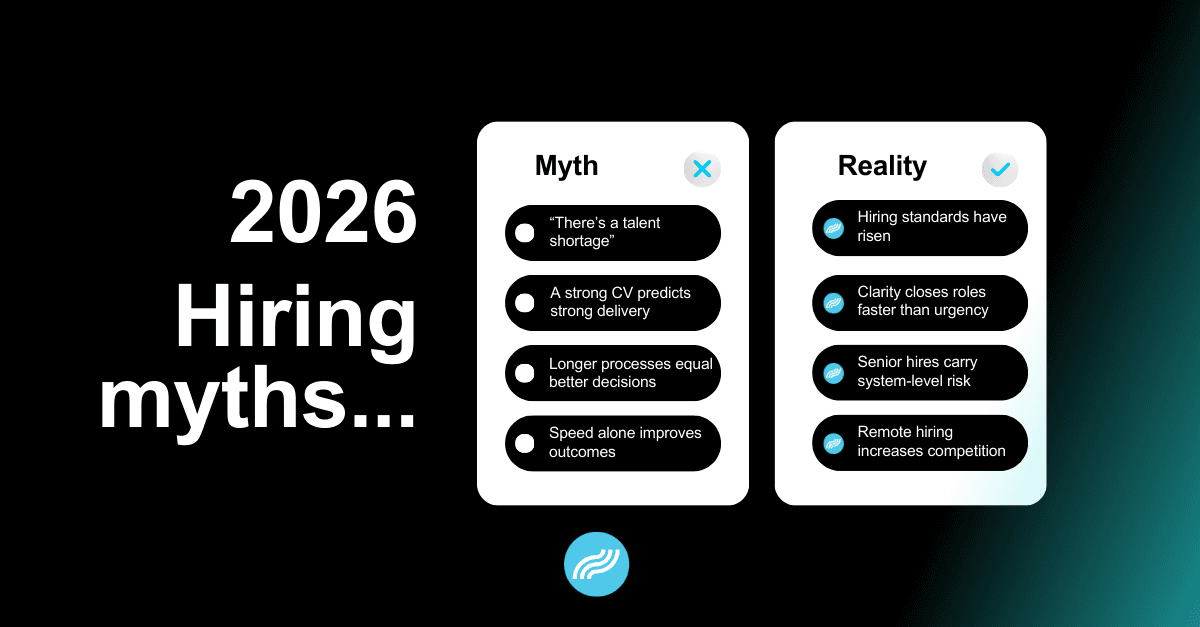
One of the most persistent narratives is that hiring has slowed because the market weakened. In practice, what many leaders are experiencing is a rise in standards. Teams are placing greater emphasis on ownership, system impact and long-term contribution. Roles are evaluated less as capacity additions and more as strategic investments. That shift feels slower because it requires more deliberate thinking. It also produces stronger alignment when done well.
Clarity has emerged as a defining factor in how effectively teams hire. Well-defined roles consistently close with less friction than positions built around broad or evolving expectations. Candidates engage more deeply when scope, ownership and success criteria are explicit. Leaders who invest time upstream in defining intent often find that hiring moves with greater momentum downstream.
Senior hiring illustrates this maturity clearly. The influence of experienced engineers and AI leaders reaches into architecture decisions, delivery culture and risk management. Treating senior hiring as a strategic act reflects an understanding that misalignment at that level carries system-wide consequences. Many leaders now approach these decisions with appropriate caution, not because confidence is low, but because impact is high.
Remote hiring has also reshaped expectations. Expanding access to talent created opportunity, though it also introduced global competition. The strongest candidates operate in a borderless market where employer clarity and credibility matter more than location advantage. Teams that understand this dynamic adjust how they position roles and communicate value.
Alongside these realities, several myths continue to shape hiring behaviour. The idea of a universal talent shortage remains common, even though many challenges stem from unclear role definition rather than candidate scarcity. Strong engineers exist in the market. Hiring friction often emerges when expectations lack precision.
Another assumption is that an impressive CV predicts delivery. Titles and company names provide context, though they rarely reveal how someone thinks, makes decisions or owns outcomes. Leaders who look beyond credentials toward responsibility and judgement gain a more accurate view of potential impact.
Process design is another area where myths persist. Lengthy hiring loops are sometimes equated with thorough decision-making. Candidates often interpret extended timelines as uncertainty rather than diligence. Clear intent, focused evaluation and decisive communication consistently produce better engagement.
Speed itself is frequently misunderstood. Accelerating hiring without alignment rarely improves outcomes. Momentum grows naturally when scope, expectations and decision authority are shared early. Leaders who prioritise alignment tend to close roles with confidence rather than urgency.
What emerges from these patterns is a picture of a hiring market that has matured. The mechanics of recruitment have not become more complicated. The expectations surrounding impact, ownership and clarity have simply become more visible. Teams that recognise this shift are building hiring practices that reflect how modern engineering and AI work actually happens.
In 2026, the strongest hiring outcomes are coming from leaders who question inherited assumptions and adapt to present conditions. Hiring is no longer treated as a volume exercise. It is a strategic function tied directly to delivery, resilience and long-term capability.
At Tides, these themes surface daily in conversations with tech and AI leaders. The organisations moving most effectively are those willing to revisit how they think about hiring itself. The myths that once guided decisions are giving way to a more deliberate, insight-led approach. That evolution is shaping stronger teams and more confident leadership across the market.
Articles


