Jan 7, 2026
Five Predictions Shaping Tech & AI Hiring in 2026
As we move toward 2026, tech hiring is entering a more deliberate phase. After years defined by rapid scaling, experimentation and shifting priorities, the market is settling into something more measured and outcome-driven. Across our work at Tides, one theme has become clear: companies that succeed in hiring next year will be the ones that value clarity, depth and delivery.
We asked members of the Tides team to share what they believe will define the next phase of tech and AI hiring. While each perspective comes from a different area of specialism, together they paint a consistent picture of where the market is heading.
Capability Over Headcount
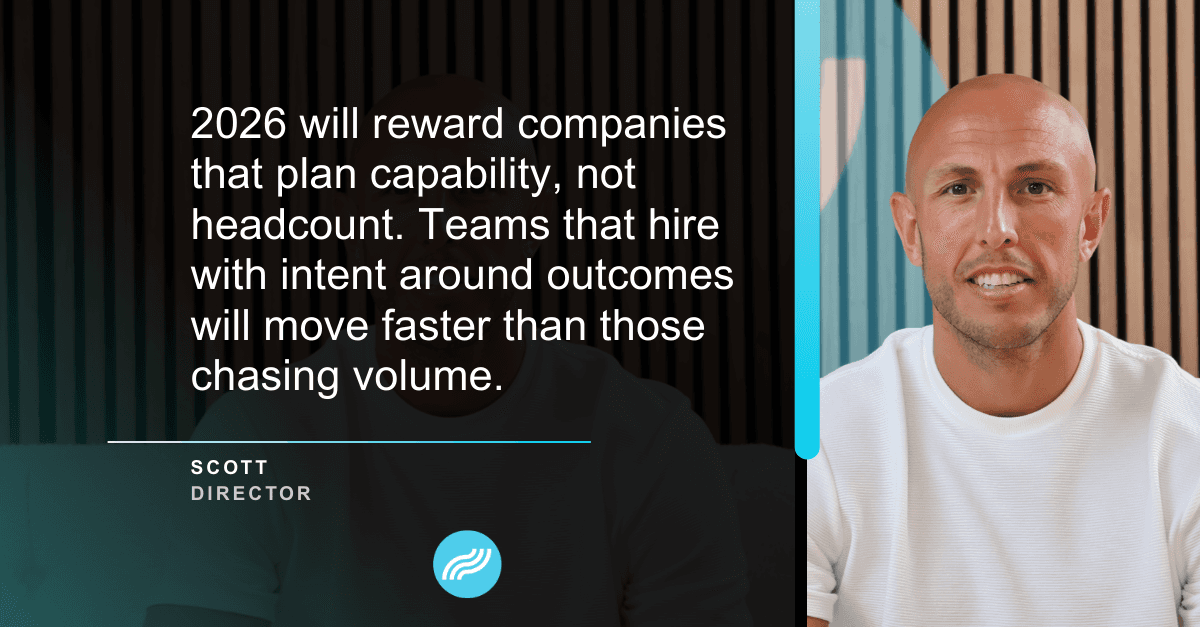
Scott’s prediction centres on a shift away from hiring volume and toward hiring intent. In recent years, many organisations focused on expanding teams quickly, often without a clear view of how each role contributed to delivery. In 2026, that approach is losing effectiveness.
Companies are beginning to plan around capability rather than numbers. This means hiring people for specific outcomes, aligning roles tightly to roadmaps, and understanding how each hire strengthens the overall system. Teams built this way move with greater confidence and avoid the inefficiencies that come with unclear mandates. Capability-led hiring creates focus and resilience, both of which matter in a more competitive talent market.
Quality-Led Delivery
From Courtney’s perspective, delivery quality will increasingly define how teams are judged. Speed alone no longer signals success. Stakeholders, clients and candidates are paying closer attention to consistency, reliability and the standard of execution.
High-quality delivery requires clear processes, strong communication and people who take ownership of outcomes. Teams that invest in these foundations earn trust and momentum over time. In hiring, this means prioritising candidates who demonstrate judgment, accountability and a commitment to doing work properly. Delivery has become a differentiator that influences reputation as much as results.
Ownership Over Tools
Charlie’s prediction focuses on Python hiring, though the principle applies more broadly. Python developers are being assessed less on the tools they use and more on how they approach problems. Framework familiarity remains useful, though it is no longer the defining factor.
Employers are placing greater value on engineers who understand context, take responsibility for decisions and follow work through to impact. Ownership signals maturity. It shows up in how developers talk about trade-offs, how they engage with product requirements and how they respond when systems evolve. In 2026, Python hiring will increasingly reward engineers who think beyond syntax and focus on outcomes.
Production Over Experimentation
Brad’s view reflects a broader shift in AI hiring. The industry has moved past early experimentation and proof-of-concept phases. Leaders are now focused on systems that operate reliably in production environments and deliver measurable value.
This changes what companies look for in AI talent. Engineers with experience deploying models, monitoring performance and managing real-world constraints are becoming central to hiring strategies. Accountability matters more than novelty. The emphasis is on engineers who can connect ideas to impact and sustain systems over time.
Infrastructure-First AI
Connor’s prediction highlights the growing importance of infrastructure in AI engineering. Model development is only one part of the equation. Reliability, scalability and performance depend on strong foundations.
AI engineers who understand infrastructure, pipelines and operational concerns will be increasingly sought after. These skills support long-term success and reduce risk as systems scale. Infrastructure-first thinking reflects a more mature approach to AI engineering, one that aligns technical ambition with practical delivery.
Taken together, these predictions point toward a market that values substance. Hiring in 2026 will favour teams that know what they need, why they need it and how each role contributes to delivery. Clarity, ownership and execution will shape decisions on both sides of the hiring conversation.
At Tides, these signals guide how we support clients and candidates. Understanding where the market is heading allows us to build teams that are prepared for what comes next, not what worked previously.
The future of tech and AI hiring belongs to organisations that hire with intent and deliver with confidence.
Articles