Mar 25, 2026
Why Agentic AI is changing how engineering teams are built
There is a shift happening in AI that is easy to miss if you are only looking at model performance or tooling.
The conversation is moving from what AI can generate to what AI can do.
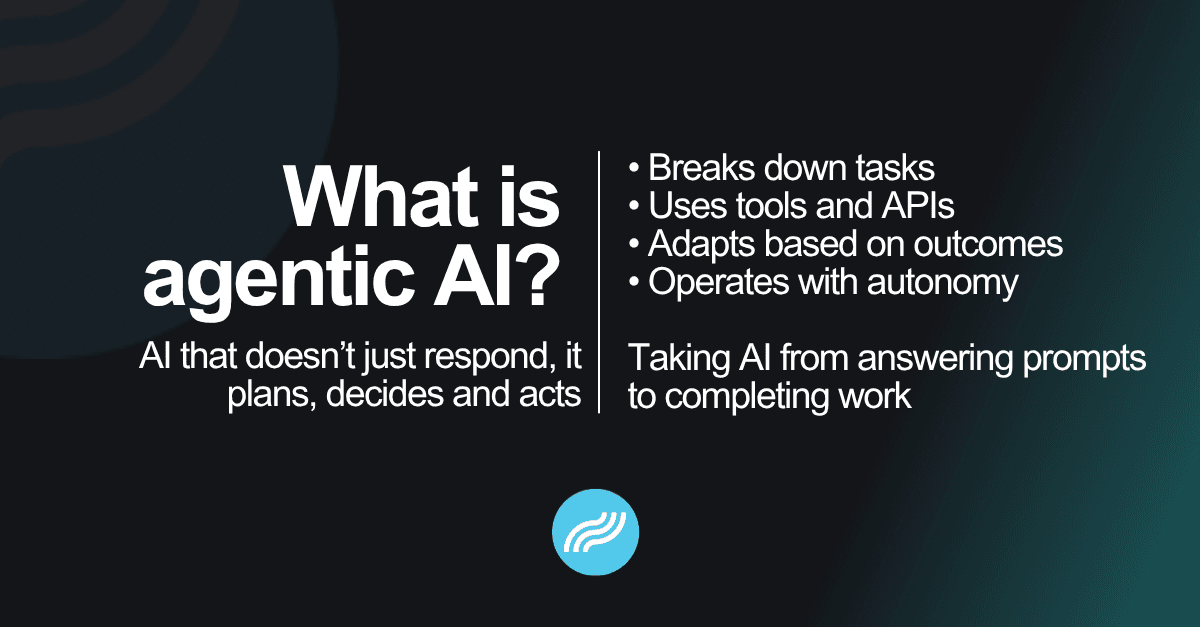
Agentic AI systems are starting to move beyond responding to prompts and into executing tasks. They plan, iterate, call APIs, retrieve data and adjust their behaviour based on feedback. In simple terms, they operate more like junior operators than tools.
This is where things start to change for engineering teams.
Most organisations are still structured around a model where software is deterministic. Engineers build systems, define logic and control how those systems behave. AI has already challenged that assumption by introducing probabilistic outputs. Agentic systems take that a step further by introducing autonomy.
That creates a different set of problems to solve.
The challenge is no longer limited to building a feature or integrating a model. It becomes about managing behaviour over time. How a system makes decisions, how it recovers from failure and how it operates safely within defined boundaries all become central questions.
These are not problems that sit neatly within a single discipline.
What we are starting to see is the emergence of engineers who sit between traditional roles. They understand how models behave, how systems are structured and how products are used in real environments. They are responsible for designing systems that include AI components that are not entirely predictable.
This is already influencing hiring.
The profiles in demand are not purely research-focused or purely backend. They are engineers who can design workflows, manage state, integrate tools and understand how decisions made by AI systems affect the wider product.
In many cases, these engineers are building orchestration layers that sit above models. They define how tasks are broken down, how tools are selected and how outputs are validated. It is a combination of engineering, product thinking and systems design.
That is a different skill set to what most teams have historically optimised for.
It also changes how teams are structured.
Rather than separating responsibilities into narrow domains, there is a growing need for engineers who can own the full lifecycle of these systems. From initial design through to monitoring behaviour in production, the work requires continuity of understanding.
This is where some organisations are starting to struggle.
They are trying to apply existing team structures to a new type of system. When ownership is fragmented, it becomes difficult to understand why an AI system behaves the way it does or how to improve it.
The teams that are moving fastest are the ones that recognise this early. They are building roles around ownership and system behaviour rather than individual components.
There is also a broader implication for how success is measured.
Traditional engineering metrics do not fully capture the performance of agentic systems. It is not only about uptime or latency. It is about quality of decisions, recovery from failure and the ability to improve over time. That requires a closer connection between engineering, product and data.
For CTOs, this is becoming a design question rather than a tooling question.
How do you structure a team to build and manage systems that are not entirely deterministic. How do you assign ownership in a way that allows those systems to evolve. And how do you hire people who are comfortable operating in that environment.
At Tides, these questions are starting to appear more frequently in conversations with technology leaders. The shift is still early, though the direction is clear.
AI is not only changing what products can do. It is changing how the teams that build those products need to operate.
Agentic AI is one of the clearest signals of that change.
Articles


